
Drainage strategy influences levels, road construction, plot sequencing and the point at which a housing development can connect into the public sewer network.
Developers and QS teams need a clear view of private drainage, adoptable infrastructure, and off-site connection requirements early enough to effectively programme approvals.
N&G Groundworks delivers Wessex Water-approved sewer requisitions, alongside foul and surface water drainage, supporting the wider drainage package.
Understand the route to the public sewer
The different roles of Section 106 connections and sewer requisitions
A Section 106 sewer connection is the formal route for obtaining consent to connect a private drain or sewer to an existing public sewer.
A sewer requisition follows a different process, commonly under Section 98 of the Water Industry Act 1991, where a new public sewer is required to serve a development, including circumstances where third-party land prevents straightforward access to the network.
Identifying the correct route helps developers plan design work, applications, land requirements and costs before the connection becomes critical to the programme.

Coordinate the wider drainage strategy
Private drainage, foul systems and surface water need compatible levels
The public sewer connection is one part of a site-wide drainage design. Plot drainage, adopted sewers, private runs, manholes, attenuation and surface water measures all need to work with finished levels and the wider construction layout.
Bringing foul and surface water drainage into the planning stage helps establish practical falls, access points and routes before foundations, roads and service corridors become fixed. For QS and site teams, this creates a clearer scope for excavation, pipework, chambers, backfill and key interfaces.
Planning adoption and approvals
Drainage agreements and technical reviews need space in the programme
Housing schemes may include drainage intended for adoption alongside private systems retained within individual plots or managed areas. Where new sewers are proposed for adoption, the design and construction requirements need to be considered alongside the connection strategy.
Technical reviews, applications, inspections and approval stages can influence when sections of drainage can be completed or connected. N&G Groundworks manages sewer requisition works from planning and design review through on-site delivery and reinstatement, helping teams align authority requirements with earthworks, sub-structures and road construction.
Build connections around live sewer risks
Controlled excavation and experienced teams support safe delivery
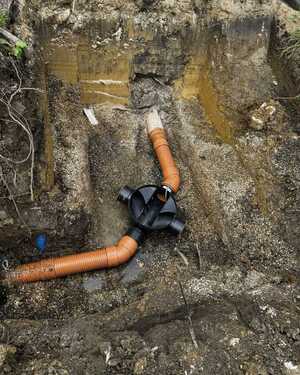
Connections to live public sewers require careful planning, appropriate approvals and safe working methods. Excavation depth, ground conditions, existing services and confined-space requirements can all affect how the work is approached.
As a Wessex Water-approved contractor, N&G Groundworks is authorised to carry out live sewer connections and diversions, including associated manholes, chambers, pumping stations and culverts. We can apply that experience directly to connection works that need close coordination with plant movements, access routes and other below-ground infrastructure.
Programme testing and inspections before backfilling
Hold points protect compliance and reduce reopening work
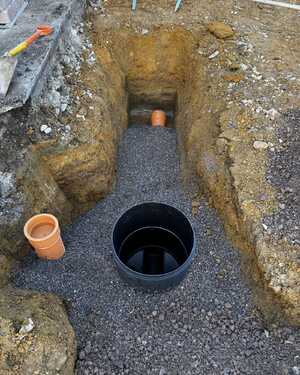
Testing and inspection stages should be built into the drainage programme. Pipe runs, chambers, connections and adopted elements may need to be checked before they are covered or brought into service.
Clear hold points give site managers time to coordinate attendance and give commercial teams better visibility over when work can progress. They also reduce the risk of completed areas being reopened for inspection or corrective work, particularly where drainage crosses roads, plot access points or areas approaching final surfacing.
Coordinate reinstatement with roads and external works
Finished levels need drainage and surfacing to work together
Once sewer connections and off-site works are complete, reinstatement needs to return roads, paths and working areas to the required standard. Cover levels, chamber positions, kerb lines and surface falls should be checked against the final external works design before surfacing begins.
Coordinating drainage with asphalt surfacing and external finishings helps avoid clashes between access covers and finished levels and reduces repeated excavation through completed areas. A joined-up sequence also gives the site team clearer handovers as the project moves from infrastructure work towards plot completion.
Use proven drainage experience on housing schemes
N&G Groundworks has delivered sewer and drainage infrastructure across housing developments of varying scales and levels of complexity.
Our extensive groundworks portfolio covers major infrastructure delivery, including a Section 104 drainage, attenuation tanks, and off-site Section 106 foul water systems completed at Broadwindsor. We also work on targeted, high-density schemes like Palmer’s Meadow, where we installed adopted sewers, private drainage, attenuation, and a wet well pumping station for a 33-home footprint.
Through practical experience, we’re able to support developers, housebuilders and QS teams that need drainage packages planned around approvals, site levels and construction sequencing from the outset.
Posted on August 28th 2026
 Updating page...